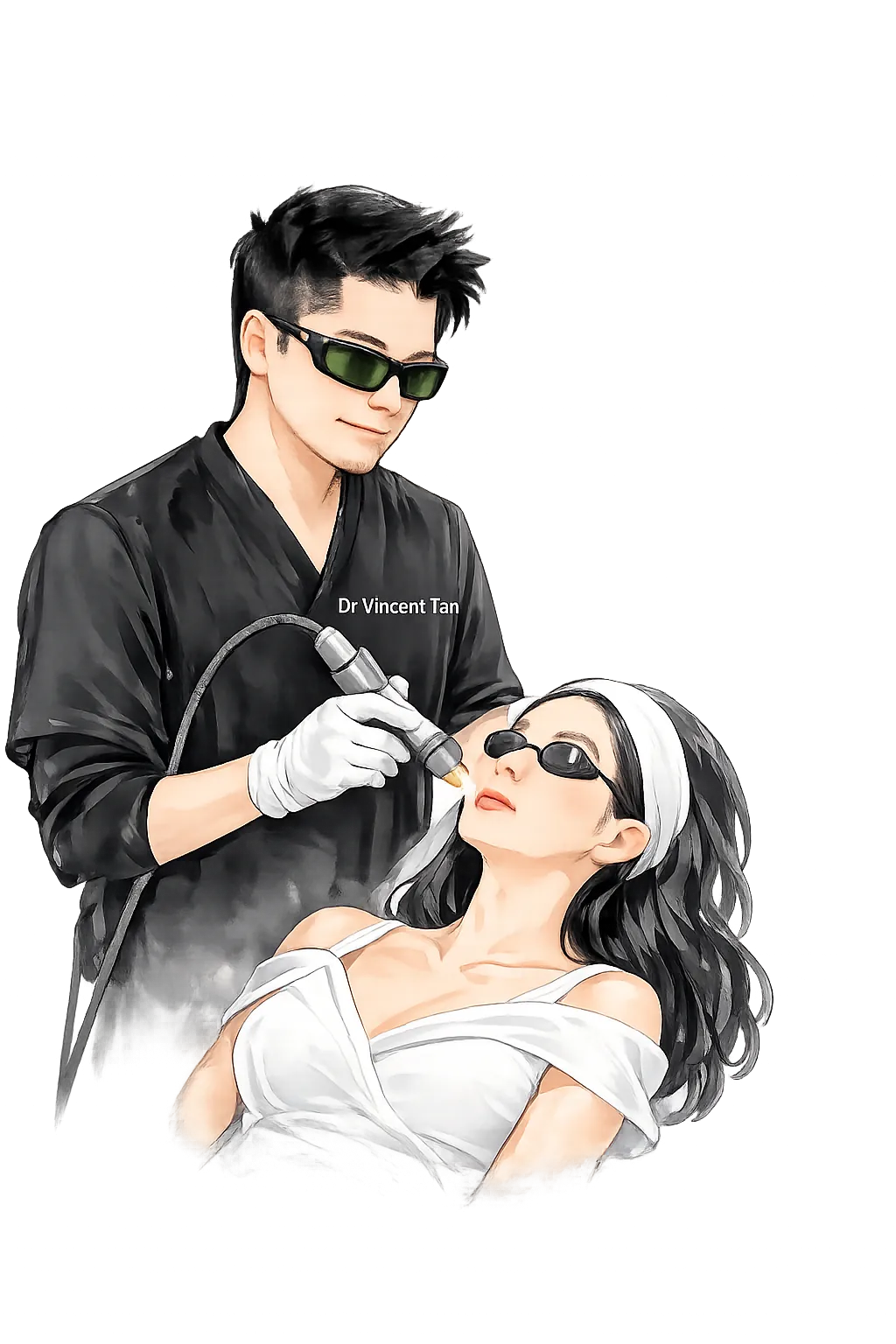
Non-Surgical Facelift
Sagging skin · Loose jawline · Volume loss · Structural descent
5 treatments
Skin Tightening
Early laxity · Crepey skin · Texture · Jawline firmness
2 treatments
Pigmentation & Pico Laser
Melasma · Dark spots · Sun spots · Uneven skin tone
1 treatment
Eye Bags & Dark Circles
Eye bags · Dark circles · Tear troughs · Puffy eyes
3 treatments
Hair Loss Treatment
Hair loss · Thinning hair · Receding hairline · Scalp health
2 treatments
Face Slimming & Contouring
Square jaw · Double chin · Undefined jawline · V-shape face
3 treatments
Body Slimming & Contouring
Stubborn fat · Muscle definition · Body shaping · Targeted fat reduction
2 treatments
Start skin quiz
RF microneedling acne scar treatment at Vincere Aesthetics Clinic, Singapore
Acne Scar Treatment

RF Microneedling for Acne Scars

MRF Scar Protocol

RF microneedling specifically targeting acne scar tissue — radiofrequency energy delivered through fine needles to break down old scarring while stimulating new collagen formation. Administered by Dr. Vincent as part of a tailored scar protocol.

Duration
60–90 min
Downtime
Minimal to none
Results
4–8 weeks
Longevity
Long-lasting
About the Treatment

About RF microneedling for acne scars

Acne scarring is fundamentally a structural problem. Scar tissue is collagen laid down hastily by the body during healing — disorganised, denser than normal skin, and resistant to surface-level treatments. Resurfacing the surface alone rarely produces meaningful change in scar depth; the scar tissue beneath remains untreated.

RF microneedling addresses scars at the level where they exist. Fine needles penetrate through the scar tissue, creating controlled micro-channels into the deeper layers. Radiofrequency energy is delivered directly through those needles — fragmenting the disorganised scar collagen and stimulating new, properly structured collagen to replace it. Over a series of sessions, the cumulative effect is meaningful texture improvement.

The protocol is intentionally more intense than the skin-tightening version of this treatment — scar tissue requires deeper, more concentrated energy delivery. Dr. Vincent treats acne scarring as a multi-modality concern: RF microneedling is often combined with subcision, polynucleotide therapy, or other interventions tailored to your specific scar pattern. The aim is optimal outcome with realistic expectations — meaningful improvement is achievable for most scar types, but full erasure is not the goal of any honest scar protocol.

Duration
60–90 min
Downtime
Skin may appear mildly pink for 24 hours or less
Results
Texture improvement progresses across a series of sessions
Longevity
Scar tissue remodelled does not undo itself
Is This for Me?

Common scar types addressed

Rolling scars

Wave-like depressions where the skin appears uneven. Among the most responsive scar types to RF microneedling, especially when combined with subcision.

Boxcar scars

Sharper, well-defined depressions with vertical walls. RF microneedling can soften the edges and rebuild dermal volume; deeper boxcar scars may need additional interventions.

Atrophic scars (general thinning)

Areas of skin where collagen has been lost during healing. RF energy stimulates new collagen to gradually rebuild dermal volume.

Mixed scar patterns

When several scar types appear together — common after moderate-to-severe past acne. RF microneedling addresses multiple scar types in one protocol.

Post-acne texture in stable skin

For clients whose acne has settled (no active lesions in the area for several months) and who are ready to begin scar work.

Your Journey

Your treatment journey

01

Scar assessment

30 min
Dr. Vincent examines your scar pattern — type, depth, distribution — and discusses whether RF microneedling alone or combined with other interventions will produce the most meaningful change. Realistic expectations are set before treatment begins.
02

Numbing & preparation

20–30 min
Topical numbing is applied across the treatment area and given 20–30 minutes to take effect. Treatment of scar tissue requires deeper energy delivery, so adequate numbing is essential for comfort.
03

RF microneedling treatment

30–45 min
The device is applied across scar areas with parameters calibrated for scar tissue. Multiple passes at varying depths target the disorganised collagen at the dermal level. The sensation is firmer than texture-only microneedling but well-tolerated when adequately numbed.
04

Recovery & series planning

15 min
Skin may appear mildly pink for 24 hours or less. Aftercare guidance is detailed. A series of 3 to 5 sessions spaced 4 to 6 weeks apart is the typical protocol; the plan is reviewed at each visit based on response.
Why Vincere

Why choose Vincere

Acne scarring is one of the more demanding aesthetic concerns to treat well. Results require realistic expectations and an honest conversation about which scars will respond meaningfully and which need a different approach. Dr. Vincent treats scars as a multi-step protocol — not a single procedure with a single answer.

RF microneedling for scars in particular requires careful parameter selection: enough energy to fragment scar collagen, but not so aggressive that recovery becomes prolonged. Optimal outcome with minimal downtime, without compromise — the same positioning applies here.

The treatment is honest about its limits. Severe ice-pick scarring, very deep boxcar scars, and certain scar types may need surgical excision or other approaches alongside RF microneedling. Dr. Vincent will tell you what is realistic at consultation — including when a different approach should be considered first.

Thousands
Energy-based procedures
3–5
Typical session count for scars
Multi
Modality scar protocol
Doctor
Personally treats every client
FAQ

Frequently asked
questions

Can't find your answer here? Message Dr. Vincent — he's happy to address your concerns personally.

RF microneedling for acne scars typically requires 3 to 5 sessions spaced 4 to 6 weeks apart. Most clients see progressive texture improvement across the series. Some scar patterns benefit from continuing beyond the initial protocol; the plan is reviewed at each visit based on response. Dr. Vincent will give you a realistic estimate at consultation.
Regular microneedling creates micro-channels at the skin surface, primarily addressing surface texture. RF microneedling adds radiofrequency energy delivered directly through the needles into the dermal layer where scar tissue exists. For structural scars, the added energy is what produces meaningful change — not just surface refinement.
Honest answer: full erasure is not the goal of any realistic scar protocol. Meaningful improvement is achievable — softer scar edges, reduced depth, smoother overall texture, better skin quality around the scars. Most clients describe the result as scars being significantly less noticeable rather than gone entirely. Dr. Vincent will set realistic expectations at consultation.
Active acne in the treatment area should generally be settled for at least several months before scar work begins, otherwise new acne lesions can form new scars even as old ones are being treated. Dr. Vincent will assess whether your skin is ready at consultation.
Treatment of scar tissue requires deeper energy delivery than skin-tightening protocols, so adequate topical numbing is essential. The sensation is firmer — described as deeper prickling combined with brief warmth — but well-tolerated when properly numbed. The discomfort settles immediately after each pass.
RF microneedling for acne scars has minimal to no social downtime. Skin may appear mildly pink for 24 hours or less, and most clients return to normal activities the same day. Strict sun protection during recovery is strongly recommended.
Yes. Because RF energy is delivered directly through needles rather than through the skin surface, it bypasses the melanin layer where some other scar treatments can cause pigmentation issues in darker skin types. This makes RF microneedling particularly useful for clients with deeper skin tones who want effective scar treatment without the pigmentation risks of certain laser-based approaches.
Ready to begin?
Reach out to Dr Vincent. No obligation, no pressure — just an honest conversation about what's possible.
Reach out